Posts

Week 8: NanoTech + Art

Image
When I saw the title of this week’s lecture, I was completely disinterested. However, after watching the lectures, I found myself intrigued with nanotechnology because it encompassed almost every aspect of what intrigued me, and Dr. Gimzewski covered a wide range of interesting topics.  What came to mind first was a piece of art that went viral a few years ago, the world’s smallest movie: A Boy and HIs Atom. This movie was a stop motion made only using atoms.  I was very interested in Dr. Gimzewski’s mentioning of Drexler’s belief that you could make a hamburger out of dirt, and I believe that this is where we are heading. When he mentioned stained glass windows as an example of nanotechnology, I got very excited. I did some more research and discovered that the gold painted on stand glass windows purifies the air. What was also interesting was his mention of quantum dots, I discovered that quantum dots are now used in television sets to create a better color qu...

Week 7: NeuroSci + Art

Image
One quote that tied the sources to my personal findings is the following from Neuroculture: ‘Certain artists have produced work that either represents the artists’ state of consciousness when creating the work of art, or evokes altered states of experience in the viewer. The drugs of choice have changed as culture has evolved.’ Whilst LSD was the drug of the 20th century, prescription drugs like Prozac and Zoloft are the mainstream drugs of the 21st century. Victoria Vesna went into detail about how LSD shaped art and science in the later half of the 20th century, with psychologists like Timothy Francis Leary accidentally marketing LSD as a recreational drug, and the CIA’s work in Project MKUltra. Henri Michaux, during the 60’s, created works heavily inspired by mescaline and LSD, which featured a series of Pollock-esque lines and dots. He later said the drug diminished his creativity. My project for another class has prompted me to research bipolar medication an...

Week 6: BioTech and Art

Image
In this blog I’ll be looking into BioTech and Art in relation to food. The conversation surrounding GMOs has been going on for years, and the consensus is divided between people who believe food should not be genetically modified, and food should be genetically modified in certain cases where it is for the benefit of humans and not of greed. A video that has been circulating for a few years shows McDonald’s food gathering mold next to normal food. The McDonald’s burgers mold slower than the regular burger, but the fries, after two months hadn’t molded at all. This raised questions about what McDonald’s puts in their fries so that they never mold.  Sometimes GMO food can be useful. Scientists have developed a ‘venomous cabbage’, a cabbage that is infused with scorpion poison which has been treated to not be poisonous to humans but only to animals and bugs. This is a more natural pesticide so that the cabbages will not be eaten by pests.  The Critical Art Ensem...

Event Two: mnemoawari

Image
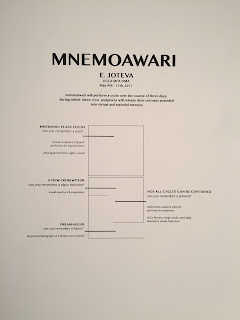
‘mnemoawari’ is the title of an exhibition by Elí Joteva. It is a combination of two ideas; the Japanese word mono no aware, referring to the beauty found within the sadness of a fleeting moment, and the Greek Goddess of memory Mnemosyne, the mother of the nine muses.  The exhibition had four parts: 3D renderings of 3 cryogenic sculptures, representing beauty immortalized, the 3 sculptures melting, representing the fleeting moment, a VR experience which put you within the sculpture, which reacted to the melting and dripping of the 3 sculptures, and an image of ‘the future’, a ball of ice made from water that stood next to someone as they slept, surrounded by the representation of brainwaves as they described their dreams.  Technology is prevalent in Joteva’s pieces through 3D renderings, VR (and the reaction of the VR to sound), monitoring of brainwaves, and in the creation of the sculptures themselves. What I learned from seeing her work is ...

Midterm

https://docs.google.com/presentation/d/1e1syPu_SyxN1-Yg9XELqforNGV7kNNWkQEQjFFlHzHM/edit?usp=sharing

Week 4: Medicine and Art

Image
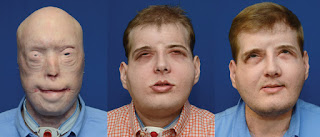
In this blogpost, I would like to focus on the topic of plastic surgery. In her lecture, Victoria Vesna talked about the history of plastic surgery. She mentioned how plastic surgery was used after World War I to repair faces. An example of that is seen today with the facial reconstruction (and one of the first face transplants) of Patrick Hardison, a fire fighter who was severely burned. His face has been completely reconstructed, showing the breadth of medical technology and innovation. Vesna also introduced us to ORLAN. ORLAN is an artist who considers her body to be a medium, like a readymade in some ways. She has undergone many plastic surgeries as performance art. In her documentary ‘Carnal Art’ she states: ‘My work is a critique on beauty and how cosmetic surgery is usually used’. She states that she also sees similarities between Catholic/ Church art and plastic surgery, the surgeon being a minister and the light shining on her face similar to the light shining on saints...

Week 3: Robotics and Art

Image
For this blogpost I decided to look into robotics and art. One example of robotics and art is the Otamatone by Maywa Denki. Maywa Denki considers themselves to be an art unit and yet the Otamatone, a musical instrument with a cute, humid face is mass produced.  This relates to Walter Benjamin’s The Work of Art in the Age of Mechanical Reproduction where he says: ‘To an ever greater degree the work of art reproduced becomes the work of art designed for reproducibility.’ The Otamatone was not meant to be only one artwork, but was designed specifically so that everyone could have and afford one. Another example where we see reproduction of robotics is in the Disney movie Wall-E.  At the beginning of the movie, we see Wall-E moving around broken versions of himself. Wall-E is a compassionate, humanoid robot who immediately pulls on heartstrings, and in the opening few minutes of the movie we see that he was mass produced. What we also see in the m...